
Matthew 2: Collage as Icon and the Massacre of Innocence
Bricolage is a creation from a diversity of materials at hand, using found objects or pieces of objects. Collage is also made from ad hoc available materials, piecing together parts into a whole. Each art technique makes something from bits of this and that. One plays with the found materials, improvising and thus, creating a new whole. Collage is glued down bits on a flat surface whereas bricolage is a sculptural technique with texture and dimensionality.
The joy of experiencing these techniques is that there is condition of possibility in finding oneself, that the piecing together of found items into a coherent narrative whole is not just external and objective, but also inner and subjective. And even if the material objet d’art is, in fact, substantially present, it is also a fleeting representation. The material whole is but a provisional reminder of creative moments existing in time and space. The past informs our choice of materials and is foundational for the emotional charge, positive or negative, of the material content. The present moment offers itself as time enough to center down into our bodily sensations, gather our ideas, feelings and thoughts as we handle the bits of glue and paper. The future impact of such creative activity is not yet known, but the act of creating gestures toward an intention, a hope, perhaps even a desire that holds or re-presents some intrinsic value that we hold dear.
I remember doing bricolage and collage in my elementary school art class. Around that same time, decoupage was also in vogue and I was gifted with some objects embellished with glue and colored patterned paper from my grandmother. That same Christmas I gifted my sister with a decoupage wooden box. She was not impressed with the found object that I had beautified by my artful application of an owl. I however, felt satisfaction about re-purposing a simple wooden box that had been abandoned in my dad’s basement workshop. I liked the process of giving something new life through glue and patterned paper. I imagined my sister would enjoy that box practically every day.
How wrong I was. That wooden box carried no emotional weight for her; it was no beloved box that held earthly treasures like in the movie, The Littlest Angel. My sister had no emotional connection to the wooden box at all. What a contrast to my hope that such a gift would be meaningful, appreciated daily as a place to hold items of importance to her.
In retrospect, I was projecting on to my sister a narrative not only from that particular Christmas movie, but also from The Kitchen Madonna, a book by Rumer Godden. The power of objective-images to reflect, mediate and re-form our emotional selves begins with tender regard, not only for others, but also for one’s very selves and the divine.
Rumer Godden tells a story set in post World War II Britain, detailing how a brother and a sister make an icon for their Ukrainian housekeeper, a war refugee. In their love for her and through ongoing conversations, they begin to understand her grief over not being in daily relation to a beloved icon of the Madonna. Icons were an important feature of her former life. The children traipse to museums to learn about icons, then set about trying to buy one for the housekeeper. In the end, they make their own Madonna using bits and pieces of what they have found, so that the kitchen feels more like home to their housekeeper due to the presence of the icon.
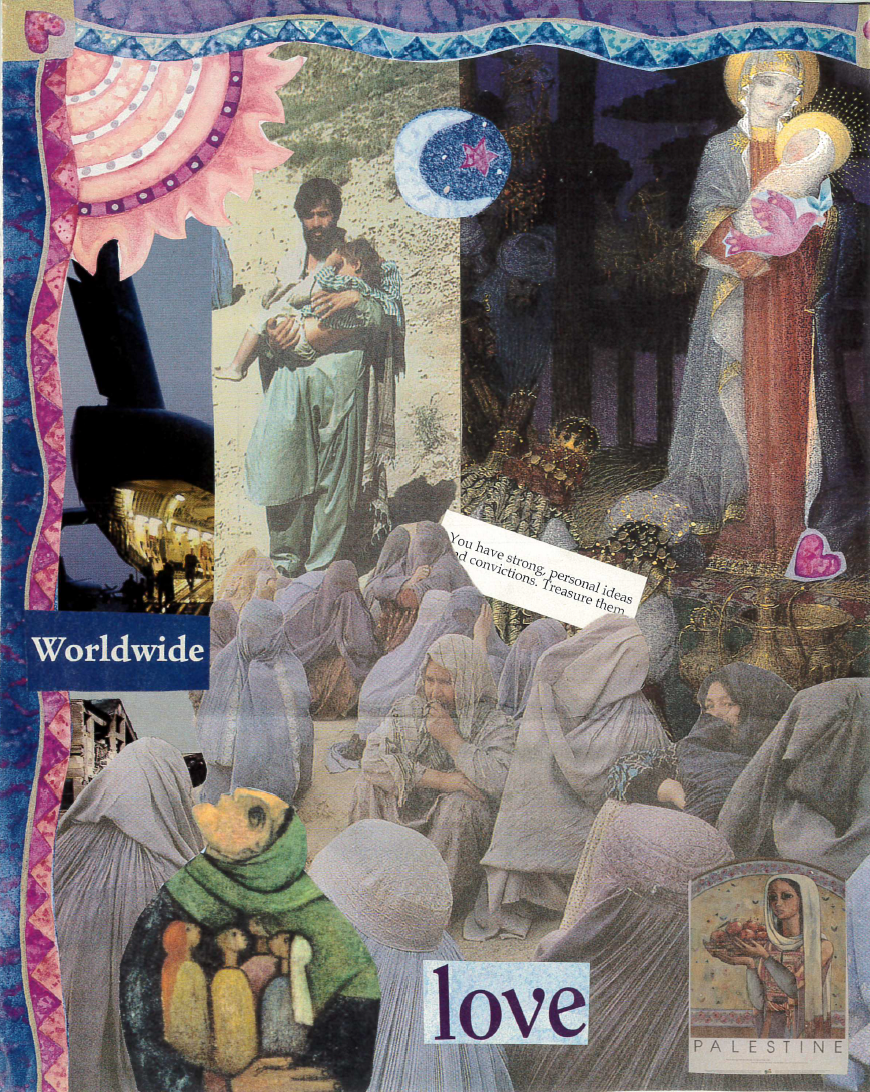
Collage created by the author in 2001 in response to geopolitical events and the liturgical season of Advent.
The power of devotionally looking at religious iconography to make inchoate sense of lives is an integral prayer practice of formation in the Eastern Church. When gazing at icons, one is seeing through to a larger whole. At a soulful level, one is emotionally connecting to a divine vision of God’s story. The bits and pieces of individual lives are caught up and refracted through the visual representation of the divine present in the lives of ordinary saints. In the beholding of an icon, one’s gaze is doubled: seeing through to an experience of God and seeing the divine eye that beholds oneself. In this religious experience of mirroring, one is seen and soothed, held safe and secure in the embrace of the divine gaze. We might say that such mirroring is an ongoing act of creation whose telos is forming us more fully into the image of the divine.
Icons help us make sense of what it means to be at home on earth with ourselves, others and the divine presence. It is a way to see through to new ways of being and helps us in our becoming as we reckon with who we have been. Collage and bricolage, even decoupage, are artful ways of representing and wrestling with aspects of our inner terrain as it relates to external events in conversation with values and commitments of Scripture and religious tradition. In a way, I view the practice of collage as a differing modality of drawing an icon.
As an adult, I returned to making collage as a response to two intersecting events: the war in Afghanistan and the necessary preparation of creating and leading workshops on the rituals of Advent. In the late autumn of 2001, we were still feeling quite new to Minnesota after years of living wherever the Marine Corps ordered my husband. We were adjusting as a family to civilian life in a place. We were grateful for nearby family. We were trying to make sense of life post 9/11 in America.
Over the national holiday of Thanksgiving, I needed time and space to make sense –life-giving sense – of war in the light of the upcoming Advent season. I was feeling deeply the paradox of war while also preparing for the ritual return of the Prince of Peace. Words didn’t make sense as a way to process the season and onset of war. Every day, I found myself cutting out colored photos from The Pioneer Press, The Minneapolis Tribune and magazines. I had to gaze on photos from the wartime theater as one way of bearing witness. From religious publications, I looked at art that theologically framed articles on the war. I thought about our life as a military family, remembered times apart when my husband was deployed to the Middle East, even as I was conscious about how, in the turning to civilian life, my husband still traveled to Middle Eastern countries.
I didn’t know what I was going to do with the newspaper and magazine images. Until I did. I knew I had to live with those images. Making a collage seemed like the thing to do. It took a weekend to make two collages. I framed them and gave them a place of prominence in my living room and study. I have lived with these images for over two decades.
In our world today, so many people are hemmed in and ground down by war. The visual focal point of our recent Confluence gathering included one of my collages amidst a crèche scene of baby Jesus in the rubble. The crèche and collage bore witness to the Scriptural story of King Herod: fear and flight, kings and baby boys coexist with dreams and death, stars and wisdom. To live with this story is to let its images work on us, that we -- like the magi – may journey on and come home to a deeper peace by “going another way.”
This other way is the third way that arises from holding the tension of paradox. The play of noticing what is and playing with visions of what ought to be leads us down paths of peace that resist violence and evil, that protect the vulnerable, that trust in emerging wisdom flung out in the sky and knit together in community.
Written by Karin Craven, 2023.
Karin is a chaplain and practical theologian who takes joy in playing with ideas, living the questions and being outdoors daily with her dog Ruby. Landscapes of the heart are Whidbey Island; windswept prairies and sloughs, bluffs and backwaters of the Mississippi River in Minnesota; and the eastern front of the Rocky Mountains. Karin lives in Missoula with her husband Bob.